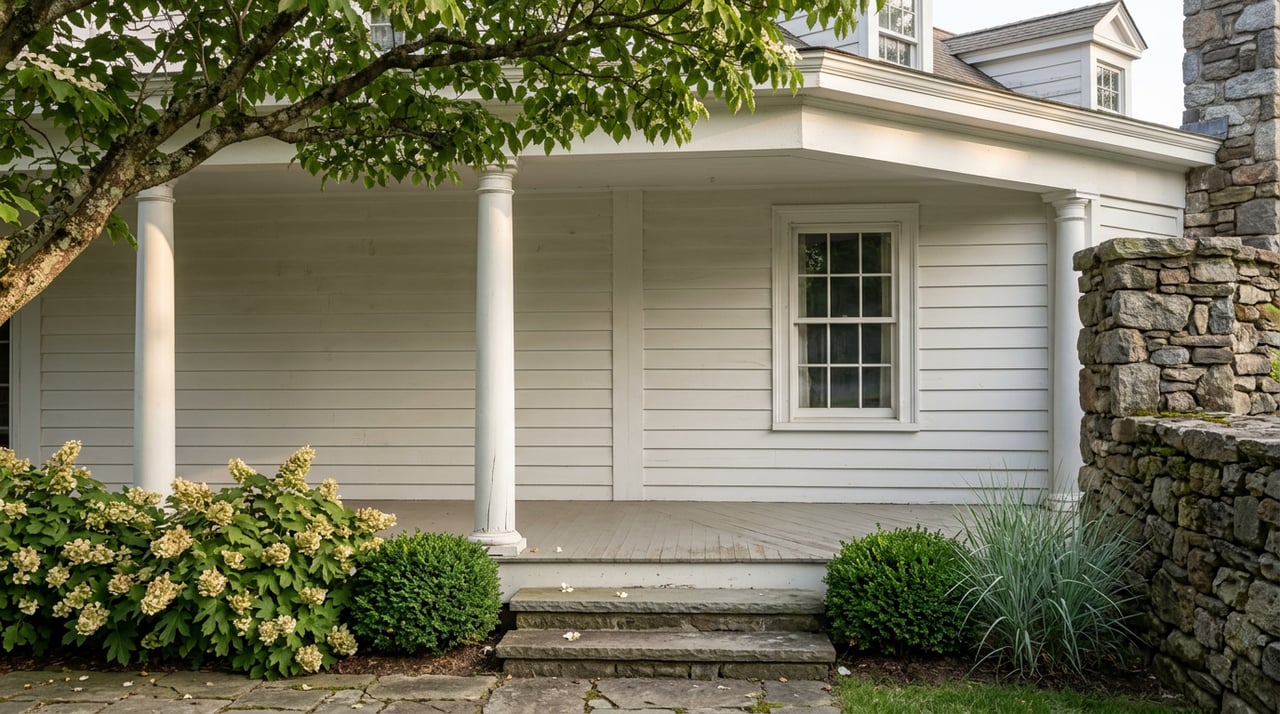
Ask someone why Greenfield Hill still feels like farmland that happens to have houses on it, and you'll get the standard answer: the one-acre zoning minimum, the old trees, the green at the center of it all. That explanation isn't wrong. It's just incomplete, and it misses the one institution that's actually been doing the work since before the zoning existed.
The zoning line explains why nobody's building a strip mall on Hillside Road. It doesn't explain why, on the third Monday of every month at 7 p.m., a room full of neighbors still gathers inside a wooden hall built in 1897 to run the same organization their grandparents ran. That keeps happening because the Grange never stopped. On August 22, that continuity becomes something you can actually walk into: the Greenfield Hill Grange Fair, which by any reasonable count is entering its 133rd year.
The Building Nobody Rezoned
The Greenfield Hill Grange chapter organized on January 23, 1893, at a moment when the hill wasn't a metaphor for rural character. It was actually agricultural, built around flax production rather than acreage minimums. The chapter began planning its own hall three years later, and the building at 1873 Hillside Road was dedicated in 1897. It's a two-story frame structure with a gabled roof and a wraparound porch on slender Tuscan columns, one of the few examples in Connecticut of a hall built purpose-built for a Grange chapter rather than repurposed from something else. The interior still has its pressed tin ceiling and plaster crown molding. The building was enlarged once, to the rear, in 1931, and it earned a spot on the National Register of Historic Places in 2008.
Here's the detail that matters more than the architecture. The fields and flax rows that surrounded the hall in 1893 are gone, and have been for a long time, yet the same local chapter still owns and runs the building. Nobody handed it off to a museum board or a preservation trust when the farming stopped. The people who show up on the third Monday just kept showing up.
| 1893 | 2026 | |
|---|---|---|
| Purpose | Farm cooperative for a flax-growing hillside | Community nonprofit, same hall |
| Membership | Roughly 200 at its height | Open meetings, third Monday, 7 p.m. |
| Building | Newly dedicated, 1897 | National Register listed since 2008 |
| Signature event | Early agricultural fairs and lectures | 133rd annual fair, August 22 |
What Actually Happens On August 22
Last year's fair, the 132nd, ran from 10 a.m. to 3 p.m., and there's no reason to expect this year's rhythm to look different. Admission is free, which has apparently never been in question for a Grange that was never trying to make money off its own neighbors in the first place.
The categories are the same ones a Greenfield Hill farmer would have entered a century ago: baking, vegetables, fruits, flowers, crafts, hobbies, and photography, all judged. Last year also brought a working guest list, not a reenactment cast: Goldilocks Farm Sanctuary of Southport brought sheep, goats, chickens, and rabbits for hands-on visits from 10 a.m. to noon, which is also why dogs weren't allowed on the grounds. Live music ran through the afternoon, alongside weaving demonstrations and a beekeeping table. None of that reads like a museum exhibit staged for effect. It reads like a working county fair that happens to be sized for one hill.
If you're planning to go up Hillside Road on the 22nd:
- Arrive between 10 a.m. and 3 p.m., based on last year's window.
- Bring cash. Baked goods and craft tables move fast and aren't set up for cards.
- Leave the dog at home if animal guests are part of this year's lineup again.
- Expect the weaving and beekeeping demonstrations to run continuously, not on a fixed schedule.
- Check the Greenfield Hill Grange's own listing close to the date, since small nonprofit fairs are the first thing to shift for weather.
The Fair Before This Fair
The Grange wasn't even the first organization on this hill to turn agriculture into a public event. Between 1901 and 1915, the building at 2829 Bronson Road served as the clubhouse for the Greenfield Hill Country Club, which ran four-day agriculture shows complete with a quarter-mile racetrack, cattle sheds, and prizes for sheep, cattle, poultry, bread, cakes, and pies. One of those shows, in 1906, reportedly featured 52 oxen on display. That tradition folded more than a century ago. The Grange picked up the same basic idea, on the same hill, and simply kept it running.
That's two generations of agricultural exhibition on the same few hundred acres, separated by a decade and a half of overlap, then handed off cleanly to an organization that's still doing it. Most Fairfield County neighborhoods can point to an old barn or a name on a street sign as evidence of a farming past. Greenfield Hill can point to an actual fair, happening in two weeks, run by the same nonprofit that's been running it since before electricity reached most of the houses nearby.
Why This Beats The Zoning Story
None of this means the one-acre minimum doesn't matter. It does, and it's the reason a builder can't quietly wedge three houses onto a lot that used to hold one. But zoning is a restriction. It stops things from happening. It doesn't explain why something specific keeps happening instead, decade after decade, without a developer or a preservation board forcing it.
The Grange does that. It's not a historic marker that people drive past. It's an open meeting on a Monday night, and a fair every August, run by the same chapter that's been doing it since flax was a cash crop on this hill. That's a different kind of continuity than large lots and old trees provide, and it's arguably the more honest explanation for why Greenfield Hill still feels distinct from every other one-acre-zoned suburb in the county. The zoning kept the acreage intact. The Grange kept the reason for the acreage alive.
If you're weighing a move to this part of Fairfield, or you already live here and have never actually walked up to the hall past the green, August 22 is a low-stakes way to see the mechanism up close. Bring cash for the bake table and expect to leave knowing your neighbors a little better than you did that morning.
For questions about buying or selling a home in Greenfield Hill or anywhere else along the coast, Lisa Babington brings the same kind of long-term, on-the-ground knowledge to every transaction. Work With Lisa when you're ready to talk about what this neighborhood, and its institutions, mean for your next move.